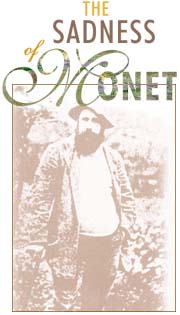
Could it be that Monet's
observations—which are
profoundly disconcerting, if
not unique—might help
explain an otherwise
imponderable phenomenon?
CLICK FOR STORY
|


F E A T U R E S
The Breath of the Earth
by Tim Steury
Carbon cycles in wondrous ways. Understanding the global carbon cycle will help us understand global climate change—and whether ancient buffers are sufficient to withstand the effects of humans.
Glacial Ice Reveals Past Climate Change
by Mary Aegerter
Glacial ice holds samples of atmospheres from hundreds of thousands of years ago. What they reveal is not comforting.
El Niño Leaves Clues in an Odd Desert
by Al Ruddy
A geoarchaeologist probes records of ancient floods in an austere Peruvian desert to understand the effects of climate change on prehistoric societies.
A Fundamental Irony
by Mary Aegerter
DNA is constantly assaulted by ultraviolet light. Fortunately, its imperfect, but efficient built-in repair mechanisms, combined with the protective ozone layer, have brought life to where it is. But what will happen as the ozone dissipates?
Plant Invasions–Global Change
by Tim Steury
Botanist Richard Mack argues that conventional ideas about global change overlook invasions—and dramatic changes—that have already occurred.
Re-Viewing Monet
by Deborah J. Haynes
Art meets moral philosophy. Monet’s paintings illuminate the ideas of Mikhail Bakhtin. And vice versa.
Ways of Seeing
by Vincent Franceschi
What we see is determined by how we look. Perception and
understanding in science require varied tools.
F I E L D N O T E S
The Re-Taking of Hong Kong
by Alex Kuo
Culture is commodity in the new Hong Kong.
|