|
Instant displacements have made Hong Kong's
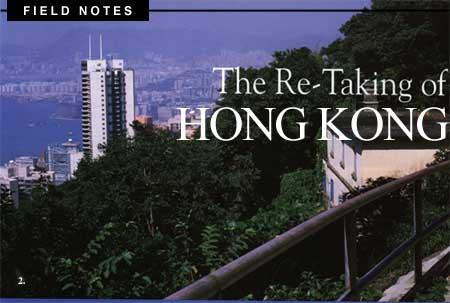
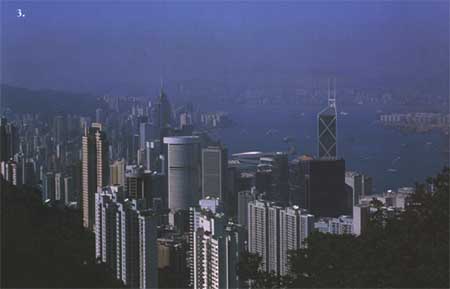
with those below (photos 1 and 4) taken from the same vantage points 44 years ago. A remaining building is a surprise, even a relief. 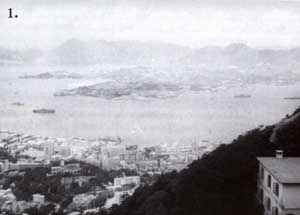 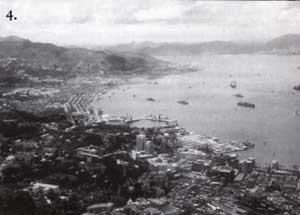
Hong Kongers are not Chinese, as if China or any other country could be meaningfully defined in such general terms. Hong Kongers stopped being Chinese the moment they left their mainland villages or cities. In coming to Hong Kong, they surrendered much of their previous identities along with their passports to the Immigration Department at the border crossing, and what has emerged in the transplantation are new cultural formations: fragments of the old, hybrids with the new, and hyphenations that separate as well as connect. This has included language for most, whose other Chinese dialects disappeared, replaced by the indigenous Hong Kong Cantonese. This has also included the creation of new customs allegedly inherited from their parents, their unassailable claim to being Chinese: for instance, to ward off bad luck, never buy a car on a Buddhist holiday, never accept a credit card or bank account number that is divisible by four, and never kill a spider on a birthday. Their origins have been forgotten, so it is said; but the disappearance that places these traditions outside the bounds of historical scrutiny makes their unexplainable practice that much more profound, especially to the unsuspecting tourist mistaking kitsch for the real thing. As a colonized Asian people, Hong Kongers have been assigned to live in the mythical and oppressive world as represented by The World of Susie Wong and Love Is a Many Splendored Thing, and such functioning but distorted perceptions that Hong Kong, the Pearl of the Orient, nicknamed Fragrant Port, is where East meets West, and that Hong Kong is bilingual. For the natives, negotiating this kind of cultural schizophrenia has necessitated the donning of two simultaneous masks. Indeed, Hong Kong’s pea blossom icon identified on the global level as an orchid (see Newt Gingrich’s perception of the relationship between China and Hong Kong as a gorilla holding an orchid in its hand) is not an orchid at all. It is a pea tree, Bauhinia blakeana Dunn (Caesalpiniaceae), not a natural species, but appropriately, a sterile hothouse hybrid named after a former governor. 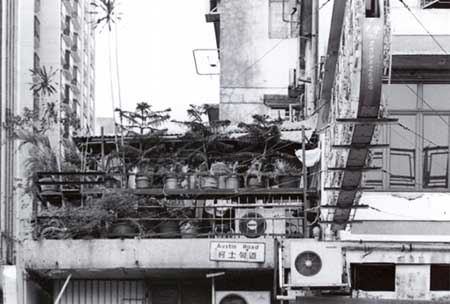 PHOTO 5: Austin Road -- a rare example of the old coexisting with the new. The disappearance of the British icons and their instantaneous substitutions are not new to Hong Kong. Hong Kongers have always worn two faces simultaneously, one in public for the public, and the other also public but waiting for the next public; one is presented to the British colonizers and their various representations, and the other to relatives and proven friends. During the Korean War and much of the 1950s Cold War, for example, the necessity for the public-public face almost spelled the demise of the next-public face, as the Chinese and Kuomintang sent down competing assassination squads in an attempt to reverse the brain drain. The British rulers refereed from the sidelines to minimize the drain on Hong Kong’s blood bank and maintain local stability by arresting and detaining just about every known political activist without trial, sometimes on the whimsical evidence of reading the wrong newspaper in public. Even the way people drive in the Hong Kong streets and walk in the many crowded shopping malls reflects their awareness of a disappearing public space, in the same way that colonized peoples all over the world have learned to hide behind anonymity. The drivers have disappeared behind the smoked glass of their late-model cars, their automated personae ruthlessly slipping the car into any empty space available, lest some other car—not its driver—occupy it first. This contested public space is viewed impersonally as something that must be taken before it too disappears, or before it is grabbed by someone else. Walking in public space has become greed at the intersection of personal place and public space. Hyperdensity in Hong Kong is not caused by limited space alone. It is exacerbated by the government’s duplicitous investments in big business and support of the associated retention and reproduction of cheap labor and minimal salaries. When Hong Kong’s new airport opens in April, the height restriction on Kowloon’s high-rises will be raised, providing yet another investment opportunity for both the government and private speculators. The existing buildings will disappear and be replaced by even higher multistoried apartments at more than two thousand dollars per square foot. It has often been said that Hong Kong reinvents itself every few years, and that the disappearance of the old must be a prerequisite for the emergence of the new. Such instant displacements have made Hong Kong’s photographed landscape unrecognizable. The remarkable new Bank of China is a 70-story high-rise visible from most of Kowloon as well as from the higher elevations of the harbor side of Hong Kong. The diagonally emphasized tower in the right third of photo 3, designed by I.M. Pei, opened in May 1990 at No.1 Garden Road. Along with the high-rises too many to count, it has totally obliterated the constructed features in its twin photograph, photo 4. That the old Bank of China building is one of the few that have survived this period between two exposures, attests to a precarious permanency attributable to its numerology as No. 2 and the hope that Pei’s new Bank of China building occupying No. 1 would survive most of the next century, even in Hong Kong’s time of bigger-better-higher-more expensive commodification. 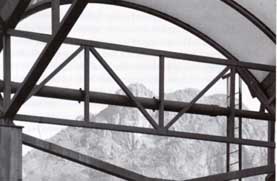 PHOTO 6: The roof of Hong Kong Baptist University: the built environment encroaches on nature. Commodity by definition is mass production in all its variants and imitations. Its product usually has a short life; it is eliminated, thrown away, laid to waste, and then just as quickly resurrected, re-marketed, and re-consumed in endless cycles. It has often been said that Hong Kong reinvents itself every few years, and that the disappearance of the old must be a prerequisite for the emergence of the new. Since buildings are obliterated and made to disappear before they become old, the Austin Road photo, photo 5, reveals a rare moment in which signs of age and decay are visible and in which the old (18 years) and the new exist side-by-side. Photo 6 shows the gradual encroachment on the few remaining acres of nature parks, here the roof of Hong Kong Baptist University pushing against the familiar Lion Rock landmark. Currently there is a growing billion-dollar industry focusing on historical preservation. It is linked to Hong Kong’s attempt to re-take its identity by turning to its past, by looking at its landmark buildings, and by looking at old photographs to construct a visual narrative of its own history. But the selectivity inherent in preservation is not memory, and if memory plays any significant part in the construction of history, preservation is then not history either, particularly not in the hands of the last-colonialists or post-colonialists. They are more interested in cultivating (read investment) artifacts such as authentic native furniture, paintings, even costumes, than they are in the total human experience including the pain and suffering that sometimes accumulates in shit. Their interest in preservation stems in part from their effort to alleviate their guilt, and in part from re-colonization as cultural piracy—except now they have to cash up—and in part from an honest attempt to see what they’ve ignored for nearly 200 years. The restoration of Kowloon’s Walled City, now devoid of drugs, prostitution, and other forms of human misery, has elevated it to the most sophisticated expression of kitsch, the theme park. Visible on Sundays and public holidays is an ironic public statement against this newest variation of late capitalism that is Hong Kong, this gargantuan economic imbalance in which a very few are making fortunes from other people’s misery. In the economics of this cycle of new replacing old, how appropriate that the colonial domestics who immigrated to Hong Kong as house servants and nannies from the neighboring Guandong Province have been replaced in the last decade by Filipino women at the next-to-lowest race rung. Like their Guandong predecessors whose choices in life were severely restricted to the service trades, these 200,000 amahs ritually take on an identity that confronts and frustrates their masters. They still do the shopping, cooking, laundry, ironing, and cleaning, and they still walk the dogs and play with the children. But on Sundays and public holidays they defy disappearance. Congregated in small groups along some of the world’s most expensive sidewalks, in front of the Hang Seng bank, the Mandarin Oriental Hotel or a similar billion dollar building as pictured in photo 7, they are not out-of-sight, and not out-of-mind. Based on shared dialect and geographic origin, their territoriality can identify them as that group from Luzon, that one from Manila, and that from Baguio, virtually a map of the Philippines. 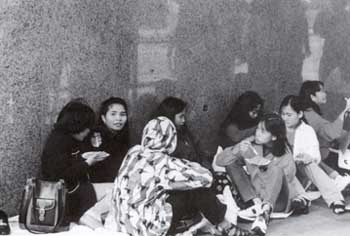 PHOTO 7: Rejecting invisibility, Filipino domestic workers occupy Hong Kong's public spaces on Sundays and holidays. If the military is the first outpost of imperialism, then surely culture will be its last. But not before the natives have acquired the practice of mimicking the masters, sometimes surpassing the rulers in their preservation of local culture. In the continuing saga of periodic reinvention, Hong Kong’s recent reunification might even be regarded as an opportunity for another makeover. The expatriates have all but disappeared from the formerly race-segregated Jockey club, its car park currently occupied by the latest Mercedes, Jaguars, BMWs, Rolls Royces, and Ferraris owned by the Hong Kong-Chinese new rich, who are into symbols of conspicuous consumption to the extreme. A provisional legislator built a temperature- and humidity-controlled wine cellar in his office suite behind thermal glass panes, so that visitors can see through them—a dramatic display for someone who admits he does not like wine. Another spent $54,000 on wine at a dinner for six so that—as he proudly admitted in an interview—he could be noticed. Perhaps this symbolic flaunting of economic excess is a statement about the need for claiming a personal narrative, a stay against a vanishing background. For now, against this changing landscape of the last half a century, there remains one inexpensive, nostalgic constant that has not disappeared: the green-and-white reliable Star Ferry that connects Kowloon and Hong Kong every 20 minutes, at 30 cents a crossing in first class. Count them: Day Star, Solar Star, Morning Star, Northern Star, World Star, Shining Star, Night Star, Golden Star, Celestial Star, Silver Star, Meridian Star, and of course, Twinkling Star. Take a ride now—who knows how soon the ongoing reclamation projects will make the harbor too shallow for even these small passenger ferries. A late update: Connie Bragas-Regalado, chair of the United Filipinos in Hong Kong, was upset on February 3 when the government, anticipating a temporary economic downturn, announced a freeze on the minimum monthly wage at US $498.26 for foreign domestic workers. She argued that her constituents would be equally impacted by the economic forecast, if not more so. (The last to arrive, the first to be victimized.) Alex Kuo is professor of comparative American cultures and English. He is on academic leave this year in Hong Kong. His novel Chinese Opera is due out in May. Copyright Alex Kuo. All photographs by Alex Kuo.
|