|
| U N I V E R S E M A G A Z I N E - S P R I N G 1 9 9 8 |



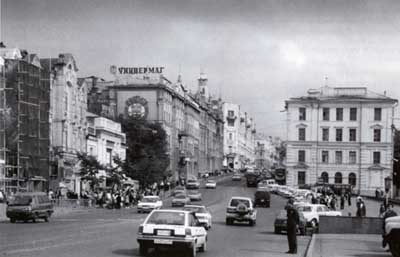
Downtown Vladivostok - Photo by Margrit von Braun.
The Russian Far East, the southeast corner of Russia on the Sea of Japan where the borders of Russia, China, and North Korea converge, lies directly across the Pacific Ocean from Washington State. It boasts unparalleled biodiverse temperate forests, for here the tropical and semitropical Chinese, Manchurian, and Korean forests of the south meet the coniferous boreal forests of the Siberian north. Its pristine, wild coast—reminiscent of the Pacific Northwest—provides habitat for Siberian tigers, brown bears, snow leopards, Himalayan black bears, wolves, raccoon dogs, various species of deer, elk, and a gray mountain goat called the ghoral.
Extensive wildlife preserves are juxtaposed against mines, areas laid to waste by Russia’s second largest lead smelter and huge clearcuts. The area has a mammoth salmon fishery alongside reserves of oil, coal, timber, gold, and other minerals. The port city of Vladivostok, its population over 600,000, is home to Russia’s Pacific fleet and the terminus of the Trans-Siberian railroad. The city was closed to all foreigners until 1992, but now promises to become a major Pacific Rim hub.
Such was the focus of discussion at the first University of Idaho/Washington State University Russian Far East Symposium held October 1997. Hosted by WSU and UI’s environmental science programs and international program offices, the symposium brought together educators and researchers from the two universities and visiting scholars from the Far Eastern State University in Vladivostok.
Jim Henson, director of international programs at WSU, spoke about the area as offering a unique opportunity for the two universities to coordinate research efforts on an international scale. Margrit von Braun, director of UI’s Environmental Science Program and symposium organizer, spoke about her collaborative work with Russian scientists to begin an environmental assessment of the effects of the lead smelter in the area. Participants spoke about their research on social issues such as cross-cultural differences between Russia and the U.S., the history of the area, and eco-tourism possibilities. Others discussed their work monitoring Siberian tiger populations, fish populations, and biodiversity, and focused on the complexities of carrying on research in Russia and the value of joint ventures involving Russian and American researchers.
The participants agreed that they should work toward organizing a larger conference on the Russian Far East, one that would bring together researchers from around the Pacific Northwest and the Russian Far East to expand contacts and research possibilities.
-- by Phil Drucker
Phil Drucker is a lecturer and assistant director of writing at the University of Idaho.
| C O N T E N T S | H O M E |
|