|
 
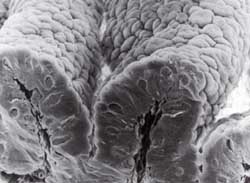 SEM photomicrograph of tobacco hornworm midgut by Kevin Wise But larval gluttony comes with certain physiological problems, which have long interested Moffett. Plant leaves, the caterpillar’s cuisine, are high in potassium and low in sodium. In contrast, much of basic physiology depends on a model high in sodium and low in potassium. In fact, says Moffett, were a traditional medical physiologist to examine the blood of a caterpillar, she would declare it impossible. Moffett has explained the mechanism by which the midgut of the tobacco hornworm secretes potassium through its membrane. In the process, Moffett also got interested in another oddity of the larval midgut. It generates extremely alkaline conditions, again the opposite of what is considered the norm. Whereas the human stomach generally has a pH of around 2, the caterpillar’s stomach has a pH as high as 11 or 12. Moffett recalls peeling back the grass in his back yard as a child and discovering the fascinating creatures that lived there. “It’s been like that ever since,” he says. “Gee, that’s interesting.” But the reality of research funding has shifted to priorities more practical, and less curiosity-driven, than ion transport in the caterpillar mid-gut. So Moffett was moved to ask what else among insects secretes alkali. The mosquito larva, it turns out, which is a major vector of disease. Do lepidopteran larvae and mosquito larvae have anything in common other than an alkaline stomach? And might the larvae’s uniqueness also be their Achilles’ heel? Moffett has recruited a post doc who has experience working with tiny tissues, and together they are exploring the possibilities. Meanwhile, Moffett was rewarded for his basic curiosity by being elected this year as an American Association for the Advancement of Science Fellow.
|