
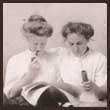
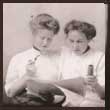
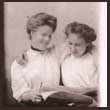
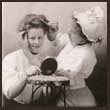
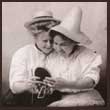
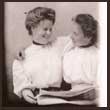
by Tim Steury When Carol Lichtenberg, curator of historical photographs at WSU’s Manuscripts, Archives, and Special Collections, introduced me to Frank Matsura’s prints and postcards, I was immediately intrigued by a small body of performative and disruptive photographs that seemed at odds with his larger promotional project. After immigrating to Seattle from Japan in 1901, Matsura moved to north-central Washington’s Okanogan County. He lived and worked in Conconully and Okanogan from 1903 to 1913, the year he died of tuberculosis. After several years washing dishes in a Conconully hotel, in 1907 Matsura opened his own tourist shop and photo studio in Okanogan, concentrating on portraiture and promotion. To entice investors and settlers to Okanogan, he documented the town’s burgeoning prosperity and the untapped potential of the land. For this reason he has been said to have left behind a historical record of the process of Okanogan’s growth. In looking at Matsura’s role in creating that historical record, I am especially drawn to the photographs he took with a multiple-lens camera called a stamp photo camera. The small, uniform shape of each frame makes me imagine the space in front of the camera as an intimate private/ public performance space, like the modern photo booths my friends and I crowded into as teenagers. I became curious about the freedom offered by the physical space occupied by Matsura, who often posed with his customers, and his subjects. The local newspapers promoted Okanogan as a settled, industrious town and enlisted citizens to solidify that identity with their behavior and public appearance. Matsura’s photographs reveal the pressure for Okanogans to develop a sense of self-consciousness about their personal actions, as the women on this page do by gazing simultaneously into a mirror and by looking directly at each other, taking inventory of themselves. In the frame wherein Matsura takes the physical place of the mirror, he highlights his part in enabling these women to see themselves from outside themselves. It is interesting also to look at how Matsura disrupted town mores. Matsura’s uniformed presence on the cover photograph—he’s the one wearing a U.S. jacket and hat—suggests trouble, likely the mixed nature of the card game. (From what I can tell, women and men did not play cards together, and here they appear to be gambling, which was certainly not encouraged.) Matsura surveys the scene, but since his gaze falls upon the cards, not the players, he seems more interested in the outcome of the game than the morals of the individuals. Posed here as a disciplinarian, Matsura neither chides the players nor stops the game, a lack of action that suggests not only his refusal to work completely within Okanogan’s social expectations, but also his conscious playful disruption of social order. I like to think about how the acting out of posed narratives works within the too-often unquestioned historical record that Matsura left behind. While his photographs reflect Okanogan’s concerns about defining its identity, they also reflect Matsura’s perceptible role in creating, not just recording, that historical record. — Kristin Harpster Kristin Harpster is a graduate student in American Studies. She was an editorial intern with Universe this spring semester. |
|