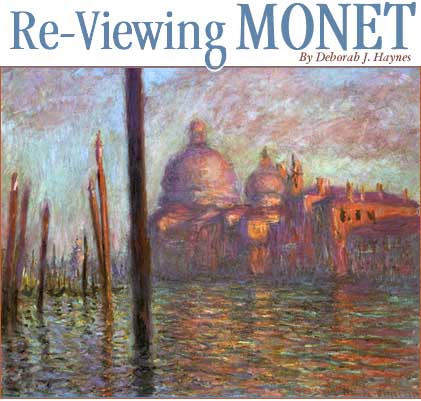
 THE GRAND CANAL, 1908 — Museum of Fine Arts, Boston. |
|

|
lthough I have lectured on Claude Monet in my 19th-century art courses, I have never felt the kind of passion toward his work that I feel, for example, toward the Russian avant-garde or toward certain strains of contemporary art that are wrestling with the impact of electronic technology. |
|
For years I’ve been convinced that it is very hard to see Monet’s prodigious production outside of its commodification. If an artist’s work is well-known and well-circulated through T-shirts, baseball caps, cookbooks, wrapping paper, and the like, what happens when we look at the “real thing”? Is it any longer possible to view Monet’s art with fresh eyes? Recently I was invited to participate in a symposium on Monet on the occasion of a new exhibition of the work he did during three journeys to the Mediterranean: in 1884 to Bordighera and the Italian Riviera; in 1888 to Antibes; and in 1908 to Venice. That symposium gave me the opportunity to explain some of Bakhtin’s concepts to an audience hitherto unfamiliar with his work, while the exhibition, “Monet and the Mediterranean,” provided me with the opportunity to reassess my own interpretation of Monet’s art. What follows is structured as a conversation between Monet’s Mediterranean paintings and the ideas of the Russian moral philosopher Mikhail Bakhtin. Although I am not a Monet scholar, I have written the first book about Bakhtin and the visual arts. The philosophical language developed by Bakhtin offers a new set of questions with which to query Monet’s painting. By focusing on concepts such as answerability, dialogue, and unfinalizability in relation to Monet’s Mediterranean paintings, I hope to broaden the scope of the conversation about Monet’s contribution to the history of painting and Bakhtin’s contribution to interpreting visual art. Bakhtin’s concepts, which are slowly finding their way into the vocabulary of art historians and critics, might well offer us ways to articulate what impressionist, as well as later postimpressionist and symbolist, artists were after. A few comments, then, about Bakhtin and Monet, whose lives overlapped. Bakhtin was born in 1895 and died in 1975. During this long life he wrote many books and essays. If one counts the writings of others in his circle such as Valentin Voloshinov and Pavel Medvedev, then the material covered ranged across an astonishing array of disciplines: literature and literary theory, history, aesthetics, axiology, biology, theology, and psychology. Bakhtin’s own writings consistently began to appear in print in the 1960s; since then his name has been associated with concepts such as carnival and dialogue or dialogism. Claude Monet’s name cannot be separated from impressionism more generally. Impressionism evolved in France as a democratic movement; it was based on the sharing of ideas, techniques, compositional recipes, and even the act of painting itself, as a number of the artists worked together, even painting the same scenes. A common style evolved for a time—a style that involved loose brushwork and the juxtaposition of unusually bright colors—but Monet had separated himself by the sixth impressionist group exhibition in 1881, preferring to work in isolation. Monet was born in 1840 and died in 1926. His first Mediterranean trip was to Bordighera, on the Italian Riviera, for 10 weeks in 1883-84. Monet took this trip on impulse with Renoir and concentrated on two motifs: the sea and the Mediterranean light. Monet’s second trip was to Antibes in 1888. It is not clear why he took the trip. He spent most of his time alone, choosing as his main theme the relationship between what is paintable and what must remain unpaintable. In letters he wrestled with several problems: his serial procedure (painting more than one picture of a subject from different vantage points and under differing circumstances); the issue of the relative incompleteness of his work; and how his happiness was linked to his identity as an artist. The third trip was in 1908, to Venice. By this time Monet was heading a considerable business, which included international sales of his paintings, especially in the United States. One hundred twenty-five paintings survive from his three sojourns in the Mediterranean, most of them small enough so that he could pack his canvases under his arm as he set out for the villa garden, the shore, or the canal. Answerability and Dialogue With this introduction in mind, let me begin my discussion of Bakhtin’s ideas such as answerability and the dialogic with a brief description of his understanding of the phenomenology of the self and self-other relationships. Unlike some of his contemporaries, Bakhtin’s goal was not to create a moral or philosophical system. Most of his essays are predicated on the presupposition that the human being is the center around which all action in the real world, including art, is organized. The “I” and the “other” are the fundamental categories of value that make all action and creativity possible (as Martin Buber’s I and Thou also articulated). Bakhtin’s early essays express this sense of the relationship of self and other with the concept of answerability. Art and life answer to each other much as human beings answer each other’s needs and inquiries in time and space. Answerability was Bakhtin’s way of naming the fact that art, and hence the creative activity of the artist, is always related—answerable—to life. For him, the idea that we are answerable, indeed obligated, through our deeds is the basis of the architectonic structure of the world and the basis of artistic creativity. In this sense his interpretation of creativity emphasized the profound moral obligation we bear toward others. Such obligation is never solely theoretical, but is an individual’s concrete response to actual persons in specific situations. Because we do not exist alone, as isolated consciousnesses, our creative work is always answering the other, if only we would recognize it. Answerability contains the moral imperative that the artist remain engaged with life, that the artist answer for life. At every point Bakhtin insisted upon obvious ethical aspects of creativity: namely that, as bodies existing in real time and space we are responsible, answerable, and obligated toward other human beings in and through the creative process. To what extent can we speak about answerability in Monet’s painting? Answerability, as responsibility or moral obligation toward others, expressed as an individual’s concrete response to actual persons in specific situations, does not seem to have been Monet’s concern. He was not concerned with how art was connected to life or with the theoretical implications of his painting practice. His attention was turned more to issues of his own commercial success than to such specifically ethical concerns. Critics Clement Greenberg and Virginia Spate have suggested that the business of art and personal profit greatly influenced Monet’s artistry. Thus, although we might not be able to speak of answerability in the sense that Bakhtin used the term, we can acknowledge that there are dialogical aspects to Monet’s work. 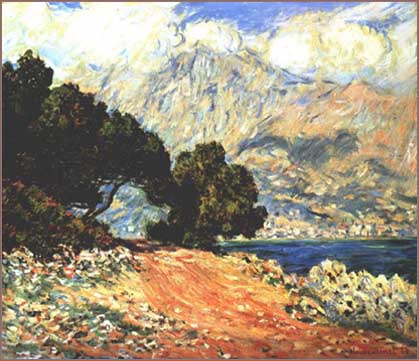 CAP MARTIN, NEAR MENTON, 1884 — Museum of Fine Arts, Boston. Bakhtin used the concept of dialogue and the dialogic in at least three distinct ways that have been described in detail by Gary Saul Morson and Caryl Emerson in their Mikhail Bakhtin, Creation of a Prosaics. First, dialogue refers to the fact that every utterance is by nature dialogic because it requires a speaker and a listener/responder. At the most fundamental level, Monet engaged in an internal dialogue with the physical world that then formed the motifs for, and pictorial elements in, his paintings. Physical elements such as light and wind, vegetation, mountains and sea, and palace facades functioned as his interlocutors. Monet also engaged in a dialogue with the past, especially with those artists who dealt with the Mediterranean, as well as with contemporaries Auguste Renoir and Berthe Morisot, among others. His dialogue with his second wife Alice Hoschedé was extremely important. While Alice may have been his primary “dialogical other,” we also must not underestimate the effect of Monet’s dialogue with another group: his critics and dealers. This range of dialogues shows that the self is never autonomous, but always exists in a nexus of formative relationships. Dialogue as I have been describing it—as utterances made in unique situations that are always directed to listeners—can either be monologic or dialogic. Although Bakhtin’s discussions sometimes lack clarity, monologism means that dialogue becomes empty and lifeless. To be truly dialogic and polyphonic, dialogue must take place through paradoxes, differing points of view, and unique consciousnesses. Communication and social interaction must be characterized by contestation rather than automatic consensus. Can we read brushstrokes as polyphonic? Isn’t there a unique kind of visual contestation of color or of directionality that expresses a dialogic and polyphonic sensibility—where rose and blue and gold meet and interact? Or, isn’t there an implicit dialogue in Monet’s serial procedure, where he painted the same scene under differing conditions, seeking to show that perception is never singular? In Bordighera, Monet painted from slightly different vantage points, capturing objective differences such as weather, lighting, the sea, and vegetation, formal differences such as size, finish, and color, and subjective differences in mood. In Venice he began to try new approaches, searching to eliminate time as a variable in his paintings so that he could concentrate on the interrelationships between the atmosphere, light, and color. Monet altered his original serial practice by painting the same place at the same time each day. Polyphony presupposes the third most general sense of dialogue. As he wrote in Problems of Dostoevsky’s Poetics, Bakhtin understood life itself as dialogue: “To live means to participate in dialogue: to ask questions, to heed, to respond, to agree, and so forth. In this dialogue a person participates wholly and throughout his whole life: with his eyes, lips, hands, soul, spirit, with his whole body and deeds. He invests his entire self in discourse, and this discourse enters into the dialogic fabric of human life, into the world symposium.” Dialogue, therefore, is epistemological: only through it do we know ourselves, other persons, and the world. Monet’s dialogue at this level has indeed left us a considerable legacy of perception and knowledge about the world. Unfinalizability The term “unfinalizability” appears in Bakhtin’s writing in a variety of contexts. Bakhtin most clearly expressed the meaning of the term in his paraphrase of one of Dostoevsky’s ideas. “Nothing conclusive,” he wrote, “has yet taken place in the world, the ultimate work of the world and about the world has not yet been spoken, the world is open and free, everything is still in the future and will always be in the future.” In Bakhtin’s formulation, this sense of freedom and openness applies not only to works of literature and art, but is an intrinsic condition of our everyday lives. Such creativity is ubiquitous and unavoidable, and for Bakhtin it should not and could not be separated from one’s responsibility toward others and toward the world. Clearly, the concept of unfinalizability does not help us to specify further differences in the levels of completeness in Monet’s painting or between the etude and the tableau. (Monet scholar John House has written extensively about the problems with Monet’s “finish” and “finishing.”) But I think the concept offers a way to think about Monet’s larger agenda. When is a work finished? Can it ever be truly finished? When is a critical perspective or audience reception complete? Monet preferred to call his paintings “completed” rather than finished. He called them “works that I decide not to touch again.” Such language suggests that he intuitively understood Bakhtin’s insight. The fact that Monet’s paintings continue to generate scholarly and public interest also verifies the central insight of Bakhtin’s concept. What can ever be fully finalized? There is always a tentative quality to one’s work, one’s action, and to life itself. Unfinalizability refers to at least two distinct levels: the ways we need others in order to finalize the self; and the ultimate unfinalizability of all things, events, and persons. Art and life are ultimately open-ended. Even though a person’s life is finalized in death, that person’s work lives on to be extended and developed by others—an insight we certainly know vis-à-vis Monet’s work. The creative process, too, is unfinalizable, except insofar as an artist says, somewhat arbitrarily, “I stop here.” Monet’s use of seriality emphasizes the unique perceivable details of each moment and each painting. His decision to stop could never be final and conclusive; and this was something he wrestled with throughout the later decades of his life. (Some Monet scholars dismiss his Venetian paintings because he did not stop soon enough!) But precisely because it is always open to change and transformation, artistic work can be a model for the possibility of change in the larger world outside the studio. Indeed, unfinalizability gives us a way to speak about the problems of representing our constantly evolving world through the lens of our diverse and ever-changing subjectivities. The fact that Monet’s life work seems to be, at least from one standpoint, about representing that open-ended flux is certainly another part of its enduring legacy. In concluding, I would like to offer one last observation about the worlds that Monet and Bakhtin inhabited. Each man expressed, in his art if not always in life, a profound optimism, a benign view of the world, a thorough lack of gloom, even under conditions of economic or political adversity. Monet’s letters may express his effort, his discontent, his struggles, his fears regarding whether his paintings were adequate to the tasks he set. From the 1880s, they do not represent the pervasive industrial changes of the period—the chimneys and smokestacks, the factories and stultifying labor, or later, the Great War. Bakhtin lived in exile in Siberia through the worst parts of the Stalinist repression, forced to work in relative obscurity as a bookkeeper and high school teacher, while some of his closest intellectual colleagues were murdered or sent to die in the gulags of the Russian Far East. In our world, Monet and Bakhtin’s optimism can be refreshing. Whether it be the long northern winter or the blistering southern summer, republican democracy, totalitarian regimes, or lawless anarchy, we need visions of the light and reminders that all of life is and must remain open to dialogue, change, and transformation. I especially wish to thank Joachim Pissarro, curator of “Monet and the Mediterranean,” for extending the invitation that stimulated my re-examination of Monet’s work, and Margaret Sherve, for helping me transform this text for Universe. |
|