|
|
|
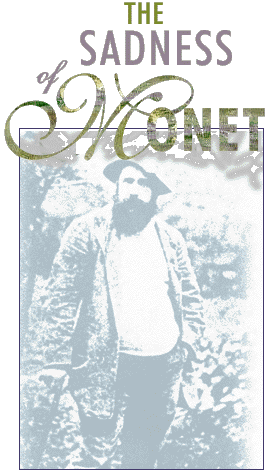
The art critic John Berger, in an essay nearly as beautiful as its subject, ponders the reasons for the sadness in Monet’s eyes. "What an Impressionist painting shows," he concludes, "is painted in such a way that you are compelled to recognize that it is no longer there." Monet in particular seemed to strive—or perhaps was compelled—to record things that cannot be recorded, things that cannot be grasped. His scenes shimmer, like memories. They are single, fleeting moments, reminders of life’s beauty and transience. Could it be that Monet’s observations—which are profoundly disconcerting, if not unique—might help explain an otherwise imponderable phenomenon? How else can we explain, at least graciously, the wave of denial confronting so many of science’s observations? Why, after such extraordinary progress in understanding our genetic machinery, are evolution and the role of genetics in human biology being questioned not only by Christian fundamentalists, but by some postmodernist academics? A recent article in the Nation recounts the story of a psychologist presenting a paper at an interdisciplinary conference on the emotions. When audience members criticized her oppressive and imperious scientific method, she attempted to defend herself, and science, by pointing to our great discoveries—DNA, for example. "You believe in DNA?" was the response. Evolution is "just a theory," one hears. Science, one hears, is "just one way of looking at things." In response to such twaddle, one scientific wag has noted that gravity is "just a theory." Perhaps we should re-examine that in high school physics classes. But perhaps I shouldn’t have said that, because someone will surely take me seriously. More immediately disturbing are the attempts to stifle public understanding of global climate change. Selective quotation, distortion, and fabrication are not new techniques in the propaganda business, but they are being used with a new sophistication to question not only the observations, but the methods of science in its attempt to understand global phenomena that might profoundly affect our children, if not us. From one perspective, such denial is perfectly understandable. There’s a lot of money to be lost if we conclude that easing the greenhouse effect will require giving up our unrestrained dependence on the automobile. Further, the realization that human activity over a very short time has changed the chemistry of the atmosphere, in a way never approached by any natural phenomenon, raises some serious questions about our notions of progress. What is more disturbing as motivation for this denial is the possibility that such denial really is a deep refusal to believe our scientific eyes, that such questioners have, perhaps unconsciously, simply chosen to refuse to believe in a change in our environment rather than do something about it. Our understanding of global climate change is far from complete, and any scientist will admit the uncertainties in trying to comprehend such a vast and complex phenomenon. But given the evidence, a small part of which is presented in this issue, one can begin to understand Galileo's despair when, faced with similar ideological skeptics, he implored, "But what will you say to the noted philosophers who, despite repeated invitations, still refuse to take a look either at the moon or the telescope and so close their eyes to the truth? "The perception of beauty is a moral test," wrote Thoreau in his journal. If we neglect to figure out what is going on, if we let what we have slip away, we have failed that test—and certainly have not appreciated the ephemera that Monet sought to portray. — by Tim Steury
|