| U N I V E R S E M A G A Z I N E - S P R I N G 1 9 9 8 |
 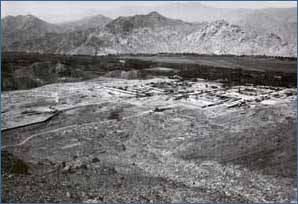
by Al Ruddy  ast summer, WSU geoarchaeologist Gary Huckleberry made his first reconnaissance of Peru’s hyperarid coastal desert and hopes to return again over the next two years to analyze a series of flood deposits that date to 2,500 years ago. “There are few places in the world,” he says, “where a rich history of complex societies coincides with an area so greatly affected by El Niño.” ast summer, WSU geoarchaeologist Gary Huckleberry made his first reconnaissance of Peru’s hyperarid coastal desert and hopes to return again over the next two years to analyze a series of flood deposits that date to 2,500 years ago. “There are few places in the world,” he says, “where a rich history of complex societies coincides with an area so greatly affected by El Niño.”The narrow strip of land between the ocean and the Andes Mountains is a cold fog desert where rainfall averages less than two inches a year. But during extreme El Niño years when warm surface water provides the source of moisture, rainfall can be devastating. At Trujillo, 400 miles north of Lima, between 1918 and 1925 total rainfall was only 1.4 inches. Then, in March 1925 the region was ravaged by 15.5 inches. Huckleberry hopes to conduct his excavations at a site called Quebrada de Los Chinos in the Moche River Valley, where agriculture has been practiced by many civilizations for nearly 3,000 years. Prehistoric farmers tapped the Moche at higher elevations and diverted the water through canals across the dry slopes to areas where they planted corn, cotton, and other crops. The hyperarid climate made these canals largely immune from floods, except for the rare El Niño events when heavy rains washed the land below 1,000 feet elevation. When those occurred, the debris would collect in areas where the flood waters lost their velocity. Huckleberry’s reconnaissance last summer identified a 100-meter-long streamcut at the mouth of Quebrada de Los Chinos. Exposed is a 12-foot-high bank of sand and gravel with periodic thin layers of organic material. The organic plant residue came from irrigated plots supported by canals and buried by flood debris, says Huckleberry. Intermixed with the organics are charcoal and cultural materials, primarily pieces of ceramic pottery that archaeologists have documented in detail according to evolving civilizations developing there. Radiocarbon techniques date the age of the charcoals. Preliminary analysis indicates 11 distinct floods associated with El Niño events over a period of 2,500 years, says Huckleberry. A detailed analysis could provide insight into the frequency of flooding by centuries or even decades. That knowledge could represent a small piece of the enormously complex puzzle of global climate change. It is also relevant to archaeological research, says Huckleberry, because El Niño had significant effects on complex prehistoric societies. “Clearly, human societies in the past have adapted to climatic variability. A possible adaptation to El Niño events may have been an increase in political centralization in order to deal with the labor necessary to repair infrastructure damaged by El Niño floods.” | C O N T E N T S | H O M E | |