by Tim Steury
Left alone, the greenhouse effect is one of those rather miraculous factors that make life on Earth not just pleasant, but possible. Earth’s atmosphere lets in rays of sunlight and traps some. The Earth absorbs the radiant energy from the sun and then releases some of it back into the atmosphere. Much of this energy is in turn absorbed by the greenhouse gases in the atmosphere. As the outgoing energy is absorbed, the atmosphere is warmed. If we didn’t have this natural greenhouse, Earth’s temperature would hover at 100 degrees below zero F. The problem is that too much of the greenhouse gases (which we make a lot of burning oil, gas, and coal) can return the heat too well. Carbon, in its diverse forms, moves through various cycles, both brief and grand, driving not just the Earth’s climate, but life itself. Every time you take a bite of food or breath of air, you’re participating in that cycle. Unfortunately, every time you start up your car, you’re helping throw that cycle out of sync. Even the most efficient cars pump more than five pounds of carbon into the atmosphere for every gallon of gas burned. Global emissions of carbon from the burning of fossil fuels reached a record 6.2 billion tons in 1996. Again, there is no debate over the increased proportion of CO2 and other greenhouse gases in the atmosphere. What is uncertain, however, is the eventual effect of such a disproportionate amount of carbon in the atmosphere and how quickly that effect will make itself obvious. Mere common sense dictates that such an increase will amplify the warming. But common sense doesn’t produce numbers or proof or cut through the oblivion of greed and ideology. That’s what scientists are for. Paleoecologist/archaeologist Peter Mehringer has long pondered ancient climates and their effect on environments and cultures. In a recent survey of environments of the Columbia Basin since the last Ice Age, he notes that “Two principles emerge from Quaternary vegetation studies worldwide: change is continual and change is unpredictable.” Mehringer studies fossil pollen, algae, and seeds, tree rings, lake levels, and carbon and oxygen isotopes in an attempt to understand the behavior of past climates. What he sees through these lenses is continual and dramatic change in the landscape of the Northwest, barely emerged from the last Ice Age. The Columbia River drainage’s familiar distribution of woodland and steppe did not approach its present form until about 4,000 years ago. Northern Idaho’s hemlock and cedar forests are even younger. Juniper woodlands have spread quickly, then retreated, then spread again. Between the last of the catastrophic floods that created them and about 10,200 years ago, eastern Washington’s Channeled Scablands were briefly covered by conifer woodlands. Then they disappeared, prey to the idiosyncrasies of climate. But climate is not the only factor that Mehringer considers in his re-creation of past environments. Fire played a large part in the drama of western environments. And much of the fire was set deliberately by early inhabitants, who used it as a management tool. For the westward migration set off by Lewis and Clark’s exploration was not the beginning of human-caused environmental change. The first humans entered western North America more than 11,000 years ago, and have been agents of change ever since. But it was only the Industrial Revolution that enabled mankind to move beyond mere regional influence and create the grand global experiment we are in the midst of today. No matter how important a part of the ecosystem earlier man was, only the burning of fossil fuels to power factories and power plants and automobiles enabled us to actually change the chemistry of the atmosphere. No matter how fickle and dramatic the effects of past climate may seem, our enormous impact was not yet a factor. But only by understanding past climate patterns can we understand the magnitude and implications of our impact. 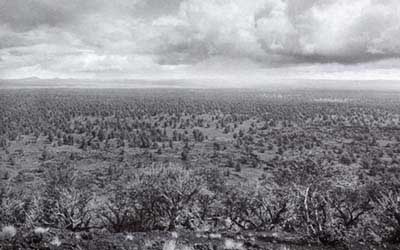 The Columbia River Basin’s familiar distribution of woodland and steppe did not approach its present form until about 4,000 years ago. Northern Idaho’s hemlock and cedar forests are even younger. In the last 5,000 years eastern Oregon’s juniper woodlands have rapidly spread, then retreated, then spread again. If piecing together past climates is one thing, predicting future climates and their effect on ecosystems is quite another. Powerful and impressive as the computer models are that give us much of our understanding of future climate change, they have decided limitations. Generally, says Rykiel, climate models and hydrology models simply reflect straightforward energy fluxes. Within these simulated climates, vegetation doesn’t grow or change with the seasons. Perhaps most important, there is in these models no carbon fixation. Carbon is fixed when it is taken out of the atmosphere through photosynthesis, then held in plant and eventually animal tissue, in ocean sediments, by the Earth itself. A measure of carbon fixation is “primary productivity.” Primary productivity is the rate at which energy from the sun is converted, primarily through photosynthesis, to organic substances. The rate of primary productivity, in other words, determines the ratio between fixed carbon and “available carbon” in the atmosphere—basically the intensity of the greenhouse effect. Rykiel’s colleagues at Pacific Northwest National Laboratory, where he worked before joining WSU, have developed, as part of PNL’s “Global Change Initiative,” a regional climate model. Most climate models are global. Curiously, says Rykiel, in some ways we understand these interactions on a global scale better than on the regional. Things can be averaged out in a global model. But smaller areas are more problematic. The Pacific Northwest, for example, is subject to extraordinarily diverse climatic and environmental factors. Rykiel is working on a vegetation component as an ecosystem model. He and his colleagues hope sometime this year to develop a connection between their hydrology model, which traces the flow of water through the environment, and their ecosystem model, so that the hydrologic response will actually account for real factors such as vegetation response, carbon fixation, and primary productivity. There has never been any systematic effort to measure primary productivity in relation to vegetation maps of the Pacific Northwest, says Rykiel. The more detailed the vegetation map, the less likely that the scientific literature has primary production data for the various vegetation types. Based on global and continental scale computer models, current educated guesses of total annual net primary productivity across the region fall between 167 and 315 teragrams (1012) of carbon per year. (At the high end, that’s 315 million metric tons of carbon or 663 million metric tons of organic matter per year.) That’s probably not a bad guess, says Rykiel, but there’s not much evidence to back it up. Rykiel and his colleagues recently collected data from existing weather stations across the Pacific Northwest and ran it through a well-known global vegetation model. What they ended up with were quite different results than would be reached by using the standard set of global climate data. What this means, says Rykiel, is that there is probably more carbon being fixed in the region than the global model predicts. Different models result in primary productivity totals that vary by a factor of two, and the field data are inadequate to decide whether one model is better than the others. Predicting the future climates of the Pacific Northwest is far from precise. Many climate models rely on remote sensing to determine vegetation types. But satellites show much of Seattle as a Douglas fir forest. How much, asks Rykiel, does agriculture account for primary productivity? A wheat field can fix as much carbon in six months as a Douglas fir forest can in a year. However, much of that carbon heads right back to the atmosphere when the wheat is harvested, the stubble perhaps burned or converted to CO2 through microbial action, the wheat made into bread, which is consumed by us, who then emit CO2 as a byproduct. And oddly, humans are often left out of the primary productivity equation, says Rykiel. He and his colleagues found a high rate of primary productivity in suburban lawns. Which could be a positive factor, were it not for the Chevy Suburbans sitting next to them. Forests occupy about 31 percent of the Earth’s land area and make up over 90 percent of the Earth’s bio-mass. They account for two-thirds of the carbon that is fixed from the atmosphere. Forests regulate not only the flow of water, but local, regional, and global climate. However, says John Bassman, a tree physiologist, we know next to nothing about what effect increased ultraviolet-B radiation will have on forests as the stratospheric ozone shield continues to disintegrate over the next century. Also, since global processes do not operate in isolation, we are equally ignorant of how UV-B will affect the ability of forests to cope with anticipated global warming. Most research on the effect of increased UV-B on plants has been done on annual plants, such as crop plants, says Bassman. But trees are much different in their relationship to increased UV-B. The most obvious difference is their longevity and the resulting increased exposure to UV-B radiation. With conifers, a single needle can stay on the tree—and be exposed to UV radiation—for up to 20 years. Another difference is trees’ annual dormancy and their overall exposure to greater environmental extremes. Also, their large size results in considerable physiological complexity, such as the transport of water from its roots to leaves far above the ground. Finally, whereas an annual plant might be able to adapt to climatic change, a tree is slow to adapt because it is so slow to respond genetically. Although public perception of increased UV-B radiation has been diverted lately by other facets of global change, the problem has not gone away. In fact, even if ozone-depleting emissions were halted immediately, the detrimental gases already in the stratosphere break down slowly. Scientists estimate that their effect on the ozone layer could continue for another 100 years. So what effect, ask Bassman and others, will the resulting enhanced UV-B exposure have not only on individual trees but on forest ecosystems? Along with botanist Gerald Edwards and Ron Robberecht, an ecophysiologist at the University of Idaho, Bassman has begun a project to gather more information on the effect of enhanced UV-B radiation on trees. But doing so is not a simple matter. In fact, one reason so little is known is the difficulty in exposing trees to measurable amounts of UV-B radiation. Ambient UV-B exposure varies constantly. Clouds, the angle of the sun, and the density of the surrounding canopy all affect how much radiation a tree is receiving. Bassman has rigged up a system that allows him to measure the UV-B output of the sun. It tracks the output second by second, then supplies multiples of that amount of UV-B to the trees, simulating natural exposure to enhanced levels of radiation. So if a cloud goes over the sun, the lamp levels correspondingly go down. As the cloud passes, the light level goes back up. The trees are subjected to the amount of extra UV-B caused by a 25 percent reduction and a 50 percent reduction in stratospheric ozone respectively. Studies on agricultural species have shown that about 60 percent are at least moderately sensitive to high levels of UV-B radiation. Among other effects is a lower rate of photosynthesis. One of Bassman and his colleagues’ primary interests is what effect UV-B might have on RUBISCO, or “ribulose 1,5-bisphosphate carboxylase oxygenase.” Ultraviolet-B radiation affects many important proteins, including DNA and RNA. RUBISCO is not only the most abundant protein on Earth, it is the primary enzyme responsible for helping plants capture carbon dioxide from the atmosphere. Based on work that’s been done on crop and herbaceous plants, Bassman and others believe that increased carbon dioxide and global warming will offer a buffer against UV-B damage—to a certain extent. Increased carbon dioxide can enhance plant growth. “But other things associated with that make the problem less than straightforward,” says Bassman. From the broadest possible perspective, he says, carbon dioxide is going to have a positive effect at least on physiology. But combine that with the negative effect of UV-B radiation on photosynthesis and the result is far from certain. One thing Bassman worries about is whether the increased UV-B radiation will change carbon allocations within trees. They may have to put more of their photosynthetic products into protective mechanisms at the expense of growth. There could be more severe direct effects, also, says Bassman. But considering the role of trees in regulating atmospheric carbon, even small effects could in turn have large effects on climate change. One earlier series of studies on loblolly pine showed that enhanced radiation caused a 20 percent decrease in biomass. Another study on sweetgum, however, resulted in no reduction in biomass, even though it did affect the rate of leaf elongation. As with other plants, the effect of increased UV-B seems to vary from species to species.  What about organic carbon beneath soils, in ground water systems? Next time you participate in that part of the carbon cycle called eating a hamburger, consider this: The average hamburger-producing cow also emits up to 350 liters of methane per day. In the United States alone, this adds up to about 5.8 million metric tons of methane per year. According to animal scientist Kris Johnson, the world’s 1.3 billion cattle account for 73 percent of 80 million metric tons of methane produced by livestock each year. Within the atmospheric scheme of things, methane concentrations are 175 times lower than CO2. That’s the good news. The bad news is that methane is 21 times as effective in absorbing and trapping radiant heat. More than 500 million metric tons of methane enter the atmosphere annually—from swamps, rice paddies, landfills, termites—and are expected to cause 15 to 17 percent of global warming over the next 50 years. Ruminant livestock produce about 22 percent of human-related methane. Johnson is part of a concentrated effort to lower each cow’s contribution to global warming. Her strategy begins with the fact that cattle typically lose 6 percent of ingested energy as eructated methane. If the carbon going into methane loss can be channeled into weight gain or increased milk production, fewer cattle will be required to meet demands. Johnson and others are examining several mechanisms that help rechannel this carbon. They include level of feed intake, the type of carbohydrate that makes up the feed, the method of processing, the addition of lipids, manipulation of ruminal microflora, and the addition of monensin to feed. Monensin is a very specific antibiotic that affects methane-producing bacteria in the cow’s rumen. A recent study by Johnson and animal scientist Ron Kincaid examined feeding canola and cottonseed as supplements to dairy cattle. Lipids in the seeds are unsaturated fats. Hydrogen that would otherwise go into methane is diverted to saturating those fats, thus lowering methane production by the cows. As one might imagine, measuring methane emissions from cattle is problematic. Past attempts to measure methane emissions generally meant putting the cattle in a sealed room, hardly a natural condition. Hal Westberg and Brian Lamb in the Atmospheric Research Laboratory developed a technique involving a tracer gas in the feed, which is gathered through a small tube near the animal’s nostrils and collected in a metal sphere hung around its neck. Consider the flow of carbon through your body. You take in carbon as plant and animal food. You breathe in oxygen, which is transported to the cells for oxidation of organic molecules. The products of this oxidation, water and carbon dioxide, you then breathe out. All organisms respire, or exchange gases with their environment, in some form. As does the Earth. The outer layer of the Earth, the soil, constantly exchanges carbon with the atmosphere in a number of ways. Plants take in carbon dioxide, which they fix into various forms of organic carbon. The plants die and are absorbed by the soil. Microorganisms feed on the organic material, which they convert back to CO2. Or animals eat the plants, excrete carbon into the soil, release CO2 back into the atmosphere. And die. And are absorbed by the soil. The turnover rate, what geochemists call “mean residence time,” of recycling carbon in this upper soil layer, is about 10 years. But the deeper the carbon, the longer its mean residence time. So perhaps it was natural for geologist Kent Keller to be intrigued by deep carbon reservoirs. Thus intrigued, Keller started to dwell on the same two questions that preoccupy so many other scientists today: What controls the greenhouse gas composition in the atmosphere? And what controls the long-term climatic evolution of Earth? These questions brought Keller back to issues that have occupied most of his research time over the last six years. What about organic carbon beneath soils, in ground water systems? How fast is it turning over? Could it potentially add to carbon dioxide in the atmosphere within human time scales? Is it a potential CO2 source we haven’t been aware of but should consider? Keller and graduate student Diana Bacon, who is now with Pacific Northwest National Laboratory, were interested in whether various factors, say a perturbation of the atmosphere or cultivation of soil, could lead to oxidation of a large amount of that organic carbon beneath the soil. Such is the case with normal soil carbon levels. In fact, scientists believe that one of the contributors to the documented increase of atmospheric CO2 in the last 40 years is simply soil disturbance. Whenever oxygen reaches soil bacteria, through tillage or the lowering of a water table, the bacteria begin respiring, turning carbon into energy and CO2. Keller and Bacon wondered if we might be pumping a lot of subsoil carbon into the atmosphere too. They found that, at least at the site they studied, there wasn’t much of a contribution to atmospheric CO2. At most about 2 percent of the total respiration from the ground surface to the atmosphere came from beneath the soil. They didn’t see any reason to think that this contribution could or would be accelerated very much by human activity. But what they had found, through an algorithmic process, is something that hadn’t been documented before—georespiration, the long, slow breathing of the Earth. The carbon source for that unimpressive 2 percent of respiration was part of a vast pool of geologic organic carbon that contains about 30,000 times the mass of carbon stored in all living matter. This pool has an almost unimaginably long turnover time of 10,000,000 to 100,000,000 years. Others had estimated what the rate of this georespiration must be, but it was largely theoretical. Keller and Bacon, however, had observed georespiration, and measured it. Their observation is significant because the rate of georespiration is one of the controls on atmospheric CO2 over long time scales. The principle is simple: If georespiration exceeds the geofixation of carbon, the burial of organic matter in coals and peats and shales, then atmospheric CO2 goes up. And vice versa. But things hadn’t yet got truly interesting. What they found at their site was that oxidation of this ancient organic matter, georespiration, was controlled by the depth of the water table. Oxygen cannot diffuse readily through water. So oxygen availability fundamental to the needs of aerobic bacterial growth, the instrument of respiration, occurs largely above water tables. Still, this is common knowledge among soil scientists. Where it really starts to get interesting is how this control might be significant if other factors start changing. What if the climate gets warmer and wetter, and water tables get shallower? The overall rate of georespiration would be inhibited, retarding an atmospheric CO2 buildup in “negative-feedback” fashion. Could it be that these deep and fundamental controls might be a long-term remedy to our best efforts to destroy our atmospheric balance? |